The fire on the altar shall be kept burning, not to go out: every morning the priest shall feed wood to it, lay out the burnt offering on it, and turn into smoke the fat parts of the offerings of well-being.
Vayikra 6:5
The commandment to keep a fire burning on the Altar is quite puzzling. The Talmud (Yoma 21b, Eruvin 63a,) states that allthe sacrifices were consumed by a Heavenly fire, not by the fire lit by the Cohanim! This seems to imply that there was absolutely no need to keep the human fire on the altar burning so as to consume the sacrifices. Even without this fire, the sacrifices would get burned through a Heavenly fire. This was an open miracle through which God showed His acceptance of the sacrifices.
In fact, the repeated commandment for the Cohanim to keep the fire burning seems to undermine the purpose of the Heavenly fire: the open manifestation of God’s miraculous providence. It gives the impression that it was not the Heavenly fire that consumed the sacrifice but the fire that was lit by men! So why have a miracle if it cannot be observed?
Spinoza and the mystery of transcendence
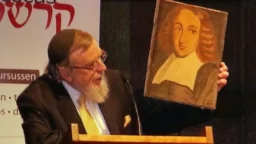
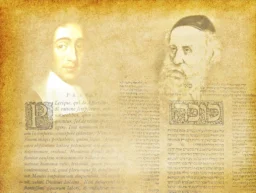
In his Ethics and Tractatus Theologico Politicus, Baruch Spinoza (1632-1677) maintains that God and nature are one and the same. God is not the Creator of the Universe but its sum total — “Deus siva Natura” (God is equal to nature). What’s more, Spinoza saw God as without personality, and thus there is no point in our speaking to Him. As such Spinoza did not recognize the biblical God.
The belief that God is synonymous with all of reality is called Pantheism. All that exists is nature, bound by natural laws. There is no “supernatural”, nor are there miracles.
This idea is in conflict with the classical Jewish conception of God, which views God as the Creator of the Universe and Someone to whom we can speak. In conventional Jewish philosophy this means that God is separate from nature, and that any attempt to equate God and nature is an attempt to limit God. (This is the reason why some consider Spinoza’s pantheism a form of idol worship, since it is nature — physical reality itself — that is seen as the Ultimate.[1])
In fact, in contrast to Spinoza, Jewish tradition might go so far as to say that there is no such thing as “nature.” Rather, “nature” is a modern word for God’s providence. In any case, it is a mistake to hold the view that God is nature; He is the Creator of nature, not identical to it.
Jewish mystics and Spinoza
Still, some Jewish thinkers believe that God is found in everything, including in nature. But their reasoning is very different from Spinoza’s.
The most important proponent of this idea is the first Chabad Rebbe, the Alter Rebbe, Rabbi Schneur Zalman of Liady (1789-1866). He argues that nothing can exist without God’s presence in it. He seems to agree with Spinoza that the only substance that exists is God. But he takes this in the opposite direction from that taken by Spinoza. He maintains that nothing else exists compared to God, because only God is absolute existence. Everything else compared to God has conditional, finite, and therefore limited existence. As such it does not really exist. Everything other than God is bound by time and space and will one day disintegrate and break down into nothingness.
In fact, Rabbi Schneur Zalman seems to go even further: He is of the opinion that there is in reality no such thing as a cosmos or anything else. In his view, the universe is only appearance, not an independent reality. From our point of view there is indeed a universe, but from God’s point of view there is no universe at all, as we read in Devarim (4:39): “Know this day and write it on your heart, that the Lord He is God in heaven above and upon the earth below. There is nothing else but Him.” This means that all that exists in the eyes of human beings is in fact, “mind-imposed” by God, an illusion.
The Alter Rebbe argues that nothing can exist unless God is “within” it. If He were to withdraw Himself from anything, that thing would return to nothingness. Not even a shell with an emptiness at the center will be left! Only God really exists and only God’s immanent presence within all things keeps “nature” permanently suspended over the void. Hence it is an absurdity to speak of nature being left to its own devices (such as Deism would argue) for if nature became separate from God it would become “non-nature” vanishing into the abyss from whence it came.[2]
This belief is called Panentheism, in contrast to the Pantheism of Spinoza.
The differences are as follows:
- For Spinoza, God and nature are one and the same, whereas, for R. Shneur Zalman God is transcendent as well as immanent. While He is in everything, He is also above everything.
- For Spinoza, the universe is necessarily eternal, as it derives its eternity from God’s eternity, but for R. Shneur Zalman the world is temporal, and God alone is eternal.
- For Spinoza God does not work through nature but is nature. For R. Schneur Zalman God is revealed in nature but also above nature.
For R. Shneur Zalman, there is really no difference between a miracle and natural law. Both are Divine. However, nature is a continual miracle, since it cannot exist on its own. The universe gives the appearance of being bound by the laws of nature, but in reality, such laws do not really exist. What we see as natural laws are simply God’s continual repetition of the same miracle. Were God to cease performing these miracles and withdraw, the universe would not fall back on the laws of nature, but instead, would cease to exist.
The continual miracle of nature
What then is the purpose of the illusion that there are laws of nature?
We can see this illusion as a means of hiding the miracle! It allows us to imagine that there are laws of nature. This is not a form of apologetics, but the foundation of our ability to be human and to recognize God.
There is a fundamental principle behind all this. The more obvious God is, the less value there is in believing in Him. Genuine faith is built on doubt. For faith to have meaning, it must be difficult and require effort. When open miracles catapult us into believing in God, we lose the opportunity to decide on our own accord to believe in Him. We simply become “believing robots”. Only doubt about God will bring us to God. We must constantly be agnostics to genuinely believe in God.
To believe in God requires great exertion, not ease. Only when God hides do we have the opportunity to search for Him.
So God needs to create an illusion which makes the impression that He does not exist. Paradoxically He does so by an “over exposure” of miracles which constantly repeat themselves, so that they become “under-exposed” and we come to believe that it is all due to “laws of nature”. However, this is an illusion designed to allow us to believe in God through our own free will.
This is also the reason that for every proof for God’s existence, there is a possible refutation, not only in philosophy but also in day-to-day living. We can see God’s hand in everything, but we can also see randomness in everything via immutable laws. It all depends on our point of departure. If we want to find God, we will find Him. If we want to deny His existence, we will find His absence. Through an infrequent miracle we may find Him. Through constant identical miracles we may deny Him.
The eternal fire
And so we return to the fire lit every day by the Cohanim on the altar. Just as God hides His miracles behind natural law, so too was the fire on the altar a camouflage to hide what was actually going on: the sole consumption of the sacrifices by the Heavenly fire! In truth no human hand was involved. But this fact had to be hidden so that human beings could believe that the laws of nature were responsible for the consumption of the sacrifice.
In reality, there were two different types of miracle at work. One happened frequently and created the illusion of the existence of laws of nature. The other happened less frequently, and stood out as a miracle. But in truth, it was the continual miracle of creation that was the greater miracle, as it constantly repeated itself. One miracle on top of another!
No doubt the more frequent miracles are a greater proof of God’s existence. But for exactly that reason they are dismissed as less miraculous, since it is all too easy to see them as natural, as Spinoza argued.
In the case of the fire on the altar, an open miracle was concealed in a basic law of nature while in fact the real cause of the consumption of the sacrifice was a more hidden miracle.
In other words, both phenomena — the unique and the continual — are ultimately equally miraculous. The sole difference is how frequently they took place. But that is only in quantity, not in essence. In essence they are equally miraculous.
Questions to Ponder
- Look at the text of the Talmud cited by Rabbi Cardozo (Yoma 21b) regarding Heavenly fire. How do the sages resolve the question of whether it was Divine or manmade fire that consumed the sacrificial offerings? How does this resolution differ from that offered by Rabbi Cardozo?
- Rabbi Cardozo suggests that there is no essential difference between miracles and natural laws; both are Divine in origin. Do you personally find this idea satisfying, or does it blur the distinction between reality and illusion to the point of intellectual discomfort? Does this idea risk trivializing the concept of miracles, making them indistinguishable from ordinary events? Alternately, does this view trivialize reality, making life seem meaningless? How would you resolve this seeming dichotomy?
- Rabbi Cardozo contrasts Spinoza’s pantheism with the Alter Rebbe’s panentheism, emphasizing that God is both immanent and transcendent. In what ways does Spinoza’s pantheistic view of God differ from the traditional Jewish conception of God as separate from nature? What are the practical implications of this difference in terms of religious observance?
- Rabbi Cardozo argues that the laws of nature are an illusion created by God to conceal constant miracles. This would appear to lead to the conclusion that God deliberately deceives human beings, rather than simply being necessarily incomprehensible to them. Is this idea consistent with a rational understanding of the universe governed by observable and consistent natural laws?
- If belief is framed as a choice between accepting or denying an illusion, does this diminish the authenticity of faith? How can we distinguish between freely chosen belief and belief that is coerced by the structure of reality itself?
Notes
[1] For a discussion of this, see: Will Herberg, Judaism and Modern Man, an Interpretation of Jewish Religion, Atheneum, New York, 1973, chapter 2.
[2] In my humble opinion, monotheism, pantheism, and panentheism all have more in common than we are prepared to admit In a certain sense they overlap, because, if they did not, God would not be eternal and infinite This may even be true of atheism and idol worship (The kabbalistic concept of God as “Ein Sof,” or “that what is without end”, has pantheistic connotations) All this requires more discussion.