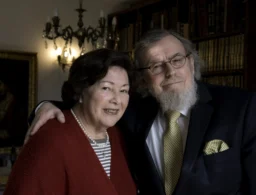
Words spoken at the funeral of my dear wife Frijda Rachel Lopes Cardozo z”l
I believe that when my wife passed away, Olam Habah, the world to come, suddenly became more beautiful because such a great soul had entered its realm.
With deep sorrow, we announce the passing of Rabbanit Freyda Rachel Lopes Cardozo z”l

Thoughts to Ponder is a weekly invitation to think dangerously and question passionately. Drawing on the Torah portion, classical Jewish sources, philosophy, and the crises of contemporary life, Rabbi Cardozo challenges religious complacency and spiritual comfort. These essays are written for readers who seek a Judaism that disturbs, questions, and ultimately deepens the human encounter with God and responsibility.
I believe that when my wife passed away, Olam Habah, the world to come, suddenly became more beautiful because such a great soul had entered its realm.
אני מאמין שאתמול, כשאשתי הוציאה את נשמתה, העולם הבא נעשה פתאום יפה יותר בעקבות הנשמה המופלאה שהצטרפה אליו.
In Moses and Parashat V'Zot HaBerachah by Rabbi Nathan Lopes Cardozo
Was Moshe Rabbeinu the greatest Jew who ever lived because he was imperfect?
The Torah tells us that Moshe was unlike any other prophet, yet it goes to extraordinary lengths to remind us of his very human origins—including the startling fact that he was born of a marriage that the Torah would later forbid.
Why would God choose such a man to lead the Jewish people?
In Moses, Theodicy and Parashat Ha'azinu by Rabbi Nathan Lopes Cardozo
Why was Moshe denied entry into the Promised Land for striking a rock? Was this really such a terrible sin? Or have we misunderstood the entire episode?
Perhaps Moshe’s mistake was not that he challenged God, but that he failed to challenge Him soon enough. What if the story of the waters of Meribah is really about something far more daring: a God who wants human beings to argue with Him, question Him, and even help “educate” Him?
And perhaps Moshe’s greatest disappointment at the end of his life was, paradoxically, his final blessing.

In Parashat Nitzavim, Rosh Hashanah and Yom Kippur by Rabbi Nathan Lopes Cardozo
Why should we be bound by a covenant we never agreed to? Moshe obligates not only those standing before him, but every future generation as well—including us.
Rosh Hashanah offers a surprising answer: perhaps the Torah is not merely something imposed upon us from without, but something already woven into who we are. And perhaps the shofar is the sound of that deeper self trying to speak.
The Woman From Auschwitz and the Persian Carpet
In Theodicy, Parashat Ki Tavo and Yom HaShoah by Rabbi Nathan Lopes Cardozo
As a teenager, I thought the Holocaust had made belief in God impossible.
Then I met a woman who had survived Auschwitz and Bergen-Belsen—and who had become religious because of what she experienced there. Her fierce response shattered my certainty and left me with a question that has never gone away: If God was there, what are we to make of His presence?
Decades later, the question remains. But perhaps we have been looking at it from the wrong direction.
Freedom and Divine Providence
In Jewish Thought and Philosophy, Spinoza and Parashat Ki Teitzei by Rabbi Nathan Lopes Cardozo
If the Torah is eternal, how can it contain stories shaped by human choice? What if Amalek had never attacked Israel? What if Yosef’s brothers had never sold him, or Moshe had spoken to the rock instead of striking it?
The Torah insists that human beings are morally responsible for their actions—yet Jewish tradition also speaks of a Torah that existed before creation. Can freedom and Divine providence both be true? Perhaps the answer lies in an unexpected place: in the very form of the Torah scroll itself.
An un-Kingly kind of King
Why would the Torah allow Israel to appoint a king at all—and then place so many restrictions on his power?
A Jewish king could not rule like the monarchs around him. He was bound by Torah, limited in wealth and military power, and forbidden to demand obedience when obedience itself became immoral. Behind these laws lies a remarkably modern question: when the authority of the state conflicts with the demands of conscience, who has the final word?
The Torah’s answer may be far more radical than we imagine.
The World Exists on Manna
In Jewish Thought and Philosophy and Parashat Eikev by Rabbi Nathan Lopes Cardozo
Memory helps us make sense of life—but it can also make the miraculous seem ordinary. The manna in the desert challenges our faith in permanence, predictability, and the supposed security of the natural world.

Why I Am still Not Religious
In Heschel, Jewish Thought and Philosophy and Parashat Devarim by Rabbi Nathan Lopes Cardozo
What does it mean to spend a lifetime trying to become religious?
On his 80th birthday, Rabbi Nathan Lopes Cardozo writes not about accomplishments or memories, but about wonder, failure, gratitude, and the lifelong struggle to remain astonished by existence.
This deeply personal letter to his children, grandchildren, and great-grandchildren is both a reflection on eight decades of life and an invitation to rediscover the extraordinary hidden within the ordinary.
In Parshiot Matot-Masei by Rabbi Nathan Lopes Cardozo
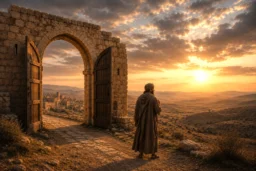
Why does the Torah devote so much attention to the Cities of Refuge?
Rav Cardozo argues that these laws are more than an ancient legal institution. They expose a condition that continues to haunt modern humanity: our inability to find rest. In a world obsessed with movement, achievement, and endless searching, could our deepest exile be spiritual rather than physical?
In Jewish Thought and Philosophy and Parashat Pinchas by Rabbi Nathan Lopes Cardozo
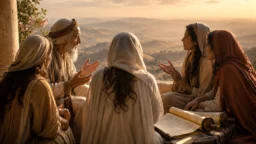
The daughters of Tzelofchad did far more than win an inheritance dispute. In challenging Moshe, they exposed something profound about the nature of Torah itself. Is even Divine law meant to remain unfinished until human beings complete it?
This week's essay explores why Judaism's greatest strength may lie not in the Written Torah, but in the courage to continue interpreting it down through the ages.